
Buying a Homes In Rhode Island’s Aging Water Infrastructure where cast iron pipes abound!
If you're thinking about purchasing in Rhode Island or you're a homeowner in Rhode Island, one thing that you may be struggling with right now, particularly if you're living in the cities of Newport or Providence, is the aging water infrastructure.
Let's talk about some steps you can take to head off expensive surprises. If you haven't yet subscribed to our channel, please subscribe today. Hit that like button if you find this content useful, and ring that bell if you like getting notified about new and interesting information about purchasing in Rhode Island.
Did you know that Rhode Island was the first state to declare independence from Britain back in 1776? (https://newenglandhistoricalsociety.com/may-4-1776-rhode-island-independence-day/)
Rhode Island celebrates Rhode Island Independence Day on May 4, and by the time the United States became an independent country, many New England and Rhode Island towns were already well over 100 years old.
01:02
The earliest water systems were developed to provide fire suppressants through a central water system. The systems were for fresh water into a centralized well or pump system since houses were more apt to burst into flames from their fireplaces in those days. The original systems used hollowed-out wooden logs. (https://tataandhoward.com/water-distribution-systems-in-new-england/)
You’ll hear all sorts of urban myths about how some of these old houses still have wooden water pipes, and that's not true. We know that modern water distribution systems that move water through communities are too high-pressure for wooden logs. But when they are digging to do new water main work or foundations, they do often find those old wooden logs.
Starting in 1770, Providence, Rhode Island, was one of the first of 15 cities in New England to create a more widespread water system for their city. And if you've driven through these two old cities in Rhode Island, Providence and Newport, you can see this large collection of colonial-era buildings.
02:06
So those water systems sometimes date back a hundred years or more. If you like living in a historic neighborhood and a historic home, you may be dealing with some of these water pipe issues.
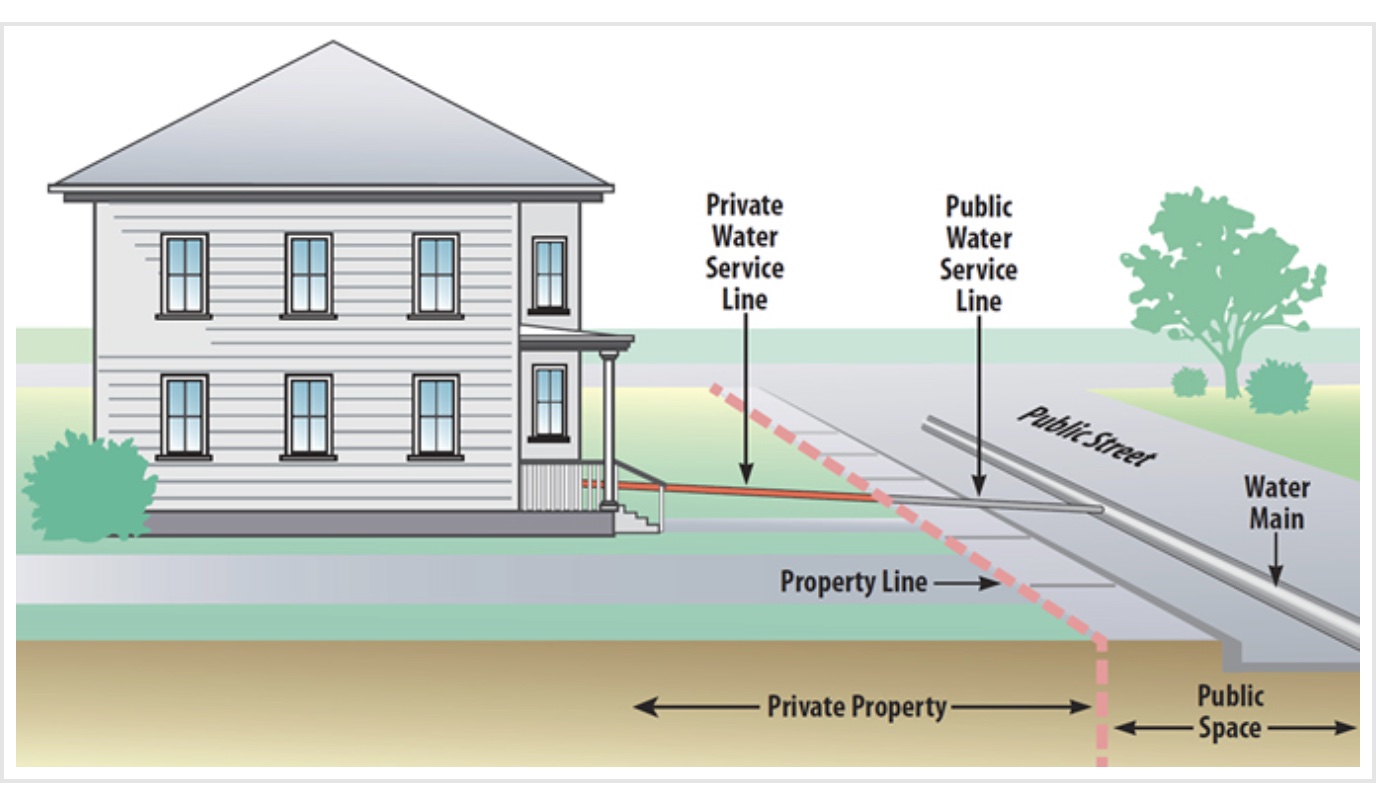
Above is a generic image of how a home might connect to a city water system. Why is this important? It varies from city to city where the line is drawn between public responsibility (i.e., the town) and the homeowner’s responsibility. Is the homeowner liable for the pipe only on their property? Or the pipe to the city main? Or does the town take responsibility for any of the connections? In the photo above its assumed that the homeowner pays for the pipe running to their property line, but every city is different. In Providence and Newport, for example, the homeowner is responsible from their home to the connection with the main line.
03:09
We don't replace cast iron with cast iron anymore, mostly because cast iron is the most expensive way to plumb your house. It is susceptible to trees digging into your roots. It is susceptible to pitting and degrading inside the pipe. And as it reaches the end of its life, you can start seeing some degradation of the quality of your water. With the pitting inside the pipes, everything gets caught on them particularly now when items like baby wipes or paper towels are flushed. (https://www.consumernotice.org/products/home-safety/cast-iron-pipes/#:~:text=The%20rough%20interiors%20of%20cast,can%20also%20corrode%20metal%20pipes.)
I know it says “flushable” on the box. (https://www.scarymommy.com/dont-flush-even-flushable-wipes ) They’re not. Ignore the hype, don’t flush the wipe. They get caught where the pipe is pitted inside, then it backs the water up.
If you're looking at a new house or an old house, a new to you but a house in a historic area, it might be a good idea to think about where it in its life cycle on the city waterlines is. What preventative or investigatory measures might you take? Will you have tenants in the home that might need more education or incentive to keep you pipes clear on wipes and towels?
04:13
How to look for potential issues in a home. Assuming you know it's connected to city sewer and water, start by looking in the basement; how much cast iron is left, and how much has already been converted to PVC? How does the cast iron look? Is it rusty? Flaking? Can you see any obvious leaks?
Secondly, you might have someone come and run a camera to the line and see if there is any damage, such as collapse or partial collapse, roots protruding through the pipe, a clog that hasn’t impacted water flow yet, or any number of issues. (Try Guaranteed Rooter, a Rhode Island company we use at Warner Realty Group)
Check out this great video on this topic from This Old House. (https://youtu.be/LFIcRlAOFw0)
In Rhode Island, a Buyer who is considering this measure should do so during the Inspection period.
05:05
Replacing a short line of cast iron is significant but not expensive as a rule. The plumber shuts off the water, cuts out the cast iron portion and adds pvc or other material. This hundreds of dollars as a rule, rather than thousands.
If the line from the house to the street, whether it's a water line or a sewer line, that's a more intensive and expensive prospect. The yard has to be dug, the street has to be dug, heavy equipment is needed and a small crew of workers. . The line has to be dug to expose it and you may also have to dig into the street. Depending on where your water line connects to your home that can be a larger job than anticipated
05:41
Forewarned is forearmed when it comes to purchasing a home. Everything in the home has a normal lifecycle and water is one of those things we don’t often think about in advance. Call a trusted rooter or plumber to give you a professional opinion about your plumbing so you can be prepared.